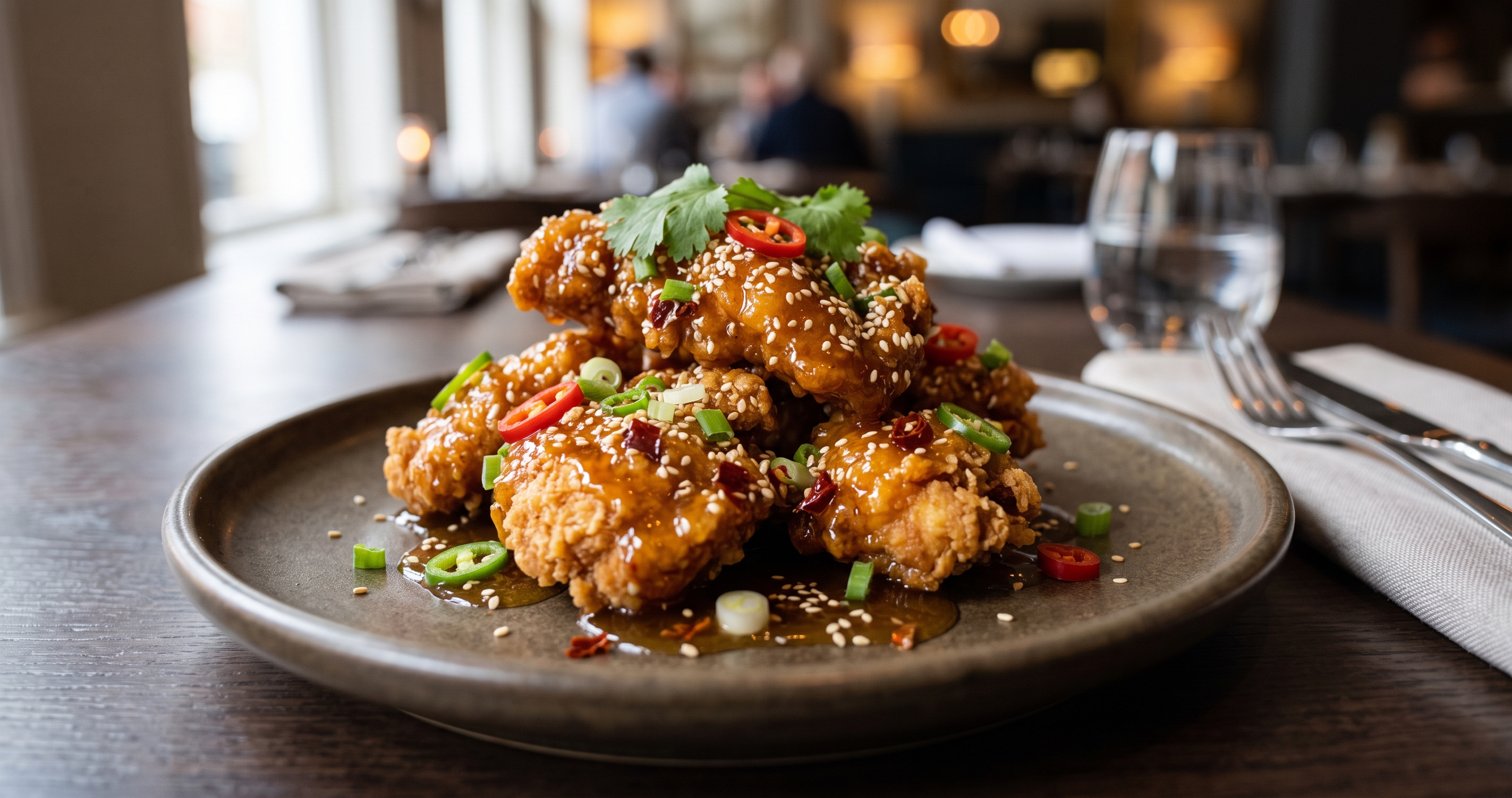
Honey chilli chicken stays crisp under its glaze for three reasons: a cornflour-heavy batter that fries into a dry, brittle shell, a second fry at higher heat that drives out leftover moisture, and a sauce reduced to a thick syrup before the chicken touches it. Toss for seconds, not minutes, and serve immediately.
Where Does This Dish Come From?
It belongs to the Indo-Chinese family, the cooking that grew out of Kolkata’s Chinese community, many of them Hakka, who settled in the city from the late eighteenth century onwards. Over generations, their wok techniques met Indian tastes: more chilli, more garlic, more sourness, and bolder colour. Chilli chicken, gobi Manchurian and Hakka noodles are the best-known results.
The honey version is a later restaurant variation rather than a dish with a long documented history, and nobody can point to a single origin. What it keeps from Indo-Chinese cooking is the logic: batter-fried pieces, high heat, a quick sauce built from soy, vinegar and chilli, and a finish of spring onion and sesame.
Chef Niaz’s cooking is grounded in Kolkata, so this style of food is familiar ground for our kitchen. We approach it the way Kolkata cooks do: fast, hot, and with no patience for limp batter.
Why Does The Coating Go Soggy In The First Place?
Sogginess is a water problem. A fried coating is crisp because it has dried into a rigid, porous network of starch and protein. Any moisture that migrates back into that network softens it.
That moisture comes from three places:
- The chicken itself. Raw chicken is mostly water. During the first fry, some of it turns to steam and escapes, but plenty stays near the surface and slowly seeps outward as the pieces rest.
- The batter. A thick, wet, flour-heavy batter traps water and fries into something closer to a pancake than a shell.
- The sauce. A thin, watery glaze soaks straight into the coating. Honey makes this worse if it is not cooked down, because sugar draws moisture from the air and from the food around it.
Fix those three and the problem largely disappears.
Which Batter Actually Stays Crisp?
Cornflour is the backbone. Unlike wheat flour, it contains no gluten, so it cannot form the chewy, bready structure that holds water. When cornflour fries, its starch gelatinises and then dries into a thin, glassy film. A little plain flour adds body and helps browning; egg white helps the coating cling without making it heavy.
The ratio we teach is roughly two parts cornflour to one part plain flour, with just enough egg white and cold water to make a coating that clings like thin yoghurt. Too wet and it slides off; too dry and it fries patchy and dusty. A pinch of baking powder adds tiny bubbles that make the shell lighter and more shatter-prone.
Cut the chicken into pieces about 2.5 cm across. Thigh is more forgiving than breast; it stays juicy through two fries.
Why Fry Twice, And At What Temperatures?
The double fry is the heart of the method.
| Stage | Oil temperature | Time | What it does |
|---|---|---|---|
| First fry | 160 to 165°C | 4 to 5 minutes | Cooks the chicken through and sets the coating |
| Rest | Off the heat, on a rack | 5 to 10 minutes | Lets internal steam move to the surface |
| Second fry | 185 to 190°C | 60 to 90 seconds | Flash-dries the coating into a hard, golden shell |
The first fry is gentle so the meat cooks before the outside overbrowns. During the rest, moisture from the centre moves outwards. The second, hotter fry drives that surface water off in a burst, leaving a shell much drier than a single fry could. Drain on a rack, not on paper, so steam can escape from underneath.
Keep batches small. Crowding the pan drops the oil temperature sharply, and cooler oil means a greasy, soft coating.
How Do You Make A Glaze That Clings Without Soaking In?
Build the sauce in the wok first, then bring the chicken to it.
Honey is mostly sugars and some water. Heated gently with soy, vinegar and chilli, the water evaporates and the mixture thickens. A small slurry of cornflour helps it set into a glossy coat. You are looking for a sauce that bubbles in large, slow bubbles and coats the back of a spoon thickly. If it runs off like water, keep reducing.
Then turn off the heat, add the double-fried chicken, and toss for 20 to 30 seconds until every piece is lacquered. Serve straight away. A glaze that is already thick only sits on the surface; a thin one gets absorbed.
A Honey Chilli Chicken Recipe That Holds Its Crunch
This honey chilli chicken recipe serves two as a main or four as a starter.
- Cut 500 g boneless chicken thighs into 2.5 cm pieces. Season with ½ tsp salt, ½ tsp black pepper, 1 tsp soy sauce and 1 tsp ginger-garlic paste. Rest 15 minutes.
- Whisk 4 tbsp cornflour, 2 tbsp plain flour, ¼ tsp baking powder, 1 egg white and 2 to 3 tbsp ice-cold water into a clinging batter. Coat the chicken.
- Heat oil to 160°C. Fry in two batches for 4 to 5 minutes until pale gold and cooked through. Rest on a rack.
- Mix the sauce: 3 tbsp honey, 1½ tbsp light soy sauce, 1 tbsp rice or white vinegar, 1 tbsp tomato ketchup, 1 to 2 tsp chilli sauce or chilli flakes, and 1 tsp cornflour stirred into 3 tbsp water.
- Raise the oil to 190°C. Fry all the chicken again for 60 to 90 seconds until deep golden and crackling. Drain on the rack.
- In a wok, heat 1 tbsp oil. Fry 3 sliced garlic cloves, 1 sliced red chilli and the white parts of 3 spring onions for 30 seconds. Add 1 small diced pepper and onion if you like, and toss for a minute.
- Pour in the sauce. Bubble for 1 to 2 minutes until thick and glossy.
- Turn off the heat. Add the chicken and toss for 20 to 30 seconds. Finish with spring onion greens and 1 tsp toasted sesame seeds. Serve immediately.
For a version close to what Kolkata cooks make, add a few slit green chillies with the garlic and a splash more vinegar.
Is It On The Menu, And Can It Be Made Halal Or Gluten-Free?
Indo-Chinese dishes appear on many menus at an indian restaurant london diners visit regularly, though recipes vary widely. If you are looking for a halal restaurant central london, the key questions are about the chicken and the sauces. At Paro our menu is tagged for halal, gluten-free, dairy-free and nut-free diners, so the team can show you quickly which dishes fit. Soy sauce usually contains wheat, which matters if you avoid gluten; tamari is the common swap at home.
Our kitchen builds most dishes on a house 48-spice mix, and that same instinct for layered seasoning shapes how we think about glazes: heat, sweetness and acidity have to land together. As an indian restaurant west end theatregoers use on Wellington Street, we see a lot of people ordering for speed before a show, and crisp fried dishes are among the fastest things a kitchen can send out. Ask the team what is cooking from the wok that day.
Frequently Asked Questions
Can I make it in an air fryer?
Yes, though the coating will be drier and less shattering than deep-fried. Swap the wet batter for a dry dredge of seasoned cornflour, spray lightly with oil and cook at 200°C for 12 to 15 minutes, shaking halfway, then toss in a well-reduced sauce.
Why use cornflour instead of plain flour?
Cornflour has no gluten, so it fries into a thin, brittle film instead of a chewy, bread-like layer. A small amount of plain flour can be added for colour and body.
How do I reheat leftovers without losing crispness?
Spread the pieces on a rack and heat in a 200°C oven for 8 to 10 minutes. Microwaving traps steam and will soften the coating.
Is the dish Chinese or Indian?
It is Indo-Chinese, a style that developed in India, most famously in Kolkata, from the cooking of the Chinese community there. It is not a traditional dish in China.
What can I serve with it?
Fried rice or Hakka noodles are the classic partners. It also works as a sharing starter alongside tandoori dishes.
Final Thoughts
A crisp glaze on honey chilli chicken is not luck. It is a light cornflour batter, a disciplined double fry, and a sauce cooked down until it can only sit on the surface. Get those right and the crunch lasts long enough to reach the table. If you would like to taste how a kitchen rooted in Kolkata cooking thinks about sweet, hot and sharp, come and see us at Paro in Covent Garden.