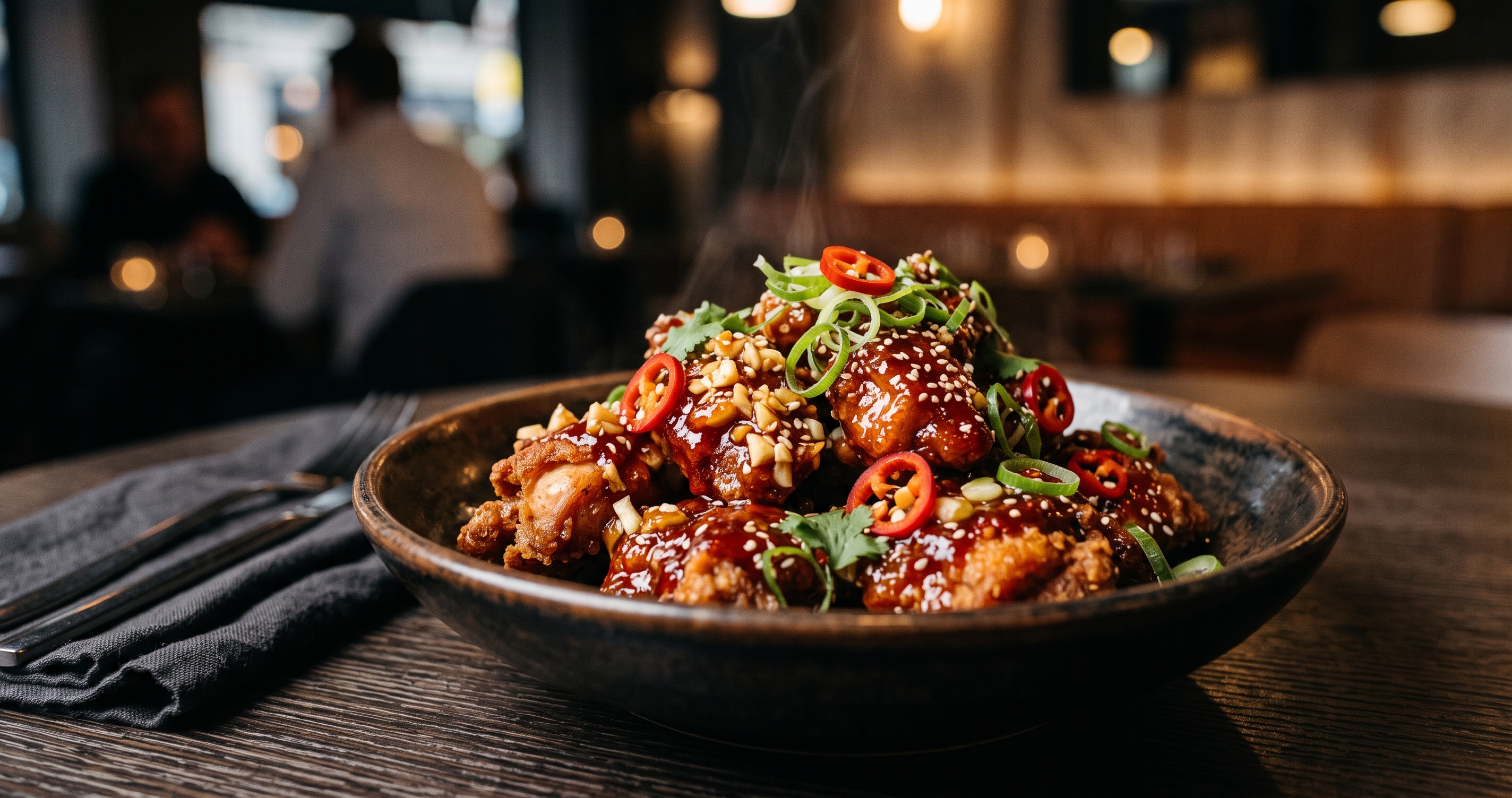
To balance garlic chilli chicken, cook the garlic gently until pale gold so it turns sweet and nutty, then add fresh green chillies late so they stay grassy and bright. Use roughly two cloves of garlic for every green chilli, slit the chillies rather than chopping them for gentler heat, and finish with a little raw garlic for punch.
What does a balanced plate actually taste like?
Think of it as two voices that should take turns rather than shout over each other. The garlic should be the warm, rounded bass note: sweet, toasty, savoury. The green chilli should be the bright top note: fresh, green, a little sharp, with heat that builds and then fades instead of sitting on your tongue for five minutes.
When it goes wrong, it goes wrong in one of three ways. Burnt garlic makes the whole dish bitter and acrid. Overcooked chillies lose their fresh flavour and leave only flat, lingering heat. Or there is simply too much of one, and the chicken disappears.
At the pass, the test we use is simple. Take one bite of chicken with sauce. You should taste garlic first, chicken second, then feel the chilli arrive a beat later. If the heat hits before anything else, the balance is off.
Why does garlic turn bitter so quickly?
Garlic is full of sugars and sulphur compounds, and it is cut small, so it has a lot of surface area for its size. In oil around 160 to 170°C, finely chopped garlic goes from raw to golden in well under a minute, and from golden to brown only seconds later. Once it browns, those sugars and compounds break down into bitter flavours that no amount of sauce will hide.
A few habits from our kitchen:
- Slice or chop, do not mince to a paste for frying. Paste burns almost instantly. Thin slices or a medium chop give you control.
- Start in warm, not smoking, oil. Add garlic to oil that shimmers gently, then let the temperature climb with it.
- Pull it at pale gold. Garlic keeps colouring in residual heat. Stop a shade before you think it is ready, or add the next ingredient to cool the pan.
- Use two stages. Fry most of the garlic early for sweetness and depth. Then add a smaller amount of finely chopped raw garlic in the last minute for sharp, fresh aroma.
The raw-versus-cooked difference has a real cause. When garlic is crushed or cut, an enzyme reaction produces allicin, the compound behind its pungent bite. Heat breaks allicin down, which is why long-cooked garlic tastes mellow and sweet. Using both gives you the full range.
How do you control the heat of fresh green chillies?
Most of a chilli’s heat comes from capsaicin, which is concentrated in the pale ribs (the placenta) that hold the seeds, rather than in the seeds themselves. How you cut the chilli decides how much of that reaches the dish.
| Cut | Heat released | Flavour | Best use |
|---|---|---|---|
| Whole, pierced once | Low | Gentle, perfumed | Background warmth in a sauce |
| Slit lengthways | Medium | Fresh and green | Our default for this dish |
| Sliced into rings | Medium to high | Bright, crunchy | Late addition for texture |
| Finely chopped with ribs | High | Sharp, fast heat | Only for those who want it fiery |
| Ribs removed, sliced | Low to medium | Very green, fruity | When cooking for mixed tolerances |
Capsaicin dissolves in fat, not water. That matters: chillies fried early in oil spread their heat through the whole sauce. Chillies added in the last minute keep their heat closer to the pieces themselves, and they keep their fresh, grassy flavour too. Green chillies vary a lot from batch to batch, so always taste a small piece of one before deciding how many to use.
What ratio and order work best for garlic chilli chicken?
For 500g of boneless chicken thigh, serving two to three, a good starting point is:
- 8 to 10 garlic cloves: 6 to 8 sliced for frying, 2 finely chopped for the finish
- 4 to 5 fresh green chillies, slit lengthways
- 1 medium onion, cut into petals
- 2 tbsp neutral oil
- 1 tbsp light soy sauce, 1 tsp vinegar, ½ tsp sugar, salt to taste
- Spring onion greens to finish
Marinate the chicken pieces for 20 minutes in a little salt, pepper, 1 tsp soy sauce and 1 tbsp cornflour. Sear them in a very hot pan in a single layer until browned and just cooked, about 5 to 6 minutes. Set aside.
Then build the sauce for your garlic chilli chicken in this order:
- Warm the oil over medium heat. Add the sliced garlic and stir for 40 to 60 seconds until pale gold.
- Add the onion petals. They cool the pan and protect the garlic. Cook for 1 minute.
- Add half the slit chillies and toss for 30 seconds.
- Return the chicken. Add soy, vinegar, sugar and a splash of water. Toss on high heat for 1 minute until glossy.
- Add the remaining chillies and the raw chopped garlic. Toss for 20 to 30 seconds.
- Finish with spring onion greens and serve at once.
The sugar is not there to make it sweet. A small amount rounds off the vinegar and softens the edge of the chilli, so the garlic comes through more clearly. Chicken thigh rather than breast matters too: thigh has more fat, and fat carries both garlic flavour and capsaicin evenly across the palate.
Where does this style of cooking come from?
Garlic chilli chicken belongs to the wider family of Indo-Chinese cooking that developed in Kolkata’s Chinese community, many of whom were Hakka. Over generations, wok techniques met Indian love of green chilli, garlic and sharp, savoury sauces. Dishes such as chilli chicken and gobi Manchurian came out of that meeting.
Chef Niaz’s cooking is grounded in Kolkata and West Bengal traditions, so this kind of quick, high-heat, garlic-forward cooking is familiar ground for our team. It also shares an instinct with Bengali home cooking, where green chillies are often added whole or slit near the end of a dish for aroma rather than raw force.
How does it fit into a meal before a show?
A fast-cooked dish like this is well suited to diners on a timetable. If you are choosing a restaurant Covent Garden theatregoers can rely on, Paro sits at 21 Wellington Street, right beside the Lyceum Theatre. As a restaurant pre theatre guests use regularly, we know how to pace a meal so you make curtain-up. Lunch runs Wednesday to Sunday from midday.
For a wider spread, an Indian thali style of eating, with several small dishes around rice and bread, lets a garlic and chilli dish sit beside something cooling like dal or a yoghurt raita. Ask the Paro team what is on the menu that day, as dishes change.
Guests often find us after searching for a restaurant Strand side or a halal restaurant central London. Our menu is tagged for halal, as well as vegan, vegetarian, gluten-free, dairy-free and nut-free diners. Tell us about any requirements, including how much heat you like, and the kitchen will guide you.
Key Takeaways
- Fry garlic gently to pale gold; brown garlic turns bitter.
- Slit green chillies for controlled heat and add most of them late.
- Use roughly two cloves of garlic per chilli as a starting ratio.
- Finish with a little raw garlic and the last chillies for freshness.
- Use chicken thigh and a pinch of sugar to carry and round off the flavours.
Frequently Asked Questions
Why does my garlic chilli chicken taste bitter?
The garlic has almost certainly browned. Fry it in warm rather than smoking oil, stop at pale gold, and add onions straight after to cool the pan.
How can I make it milder without losing flavour?
Remove the ribs from the green chillies and add them whole or slit near the end. You keep their fresh, green taste while releasing far less capsaicin.
Can I use dried chillies instead of fresh?
You can, but the dish changes. Dried chillies bring smoky, toasted heat rather than the grassy brightness of fresh green ones. Many cooks use one or two dried chillies alongside fresh for depth.
Is chicken breast fine?
It works, but it dries out faster at high heat and carries less flavour. If you use breast, cut it slightly larger and take it off the heat as soon as it is cooked through.
Final Thoughts
Great garlic chilli chicken is about timing more than quantity: sweet, pale-gold garlic laid down first, fresh green chillies added late, and a final flash of raw garlic. Get the order right and the dish tastes bright rather than harsh. Next time you are near the Lyceum, come and eat with us at Paro.