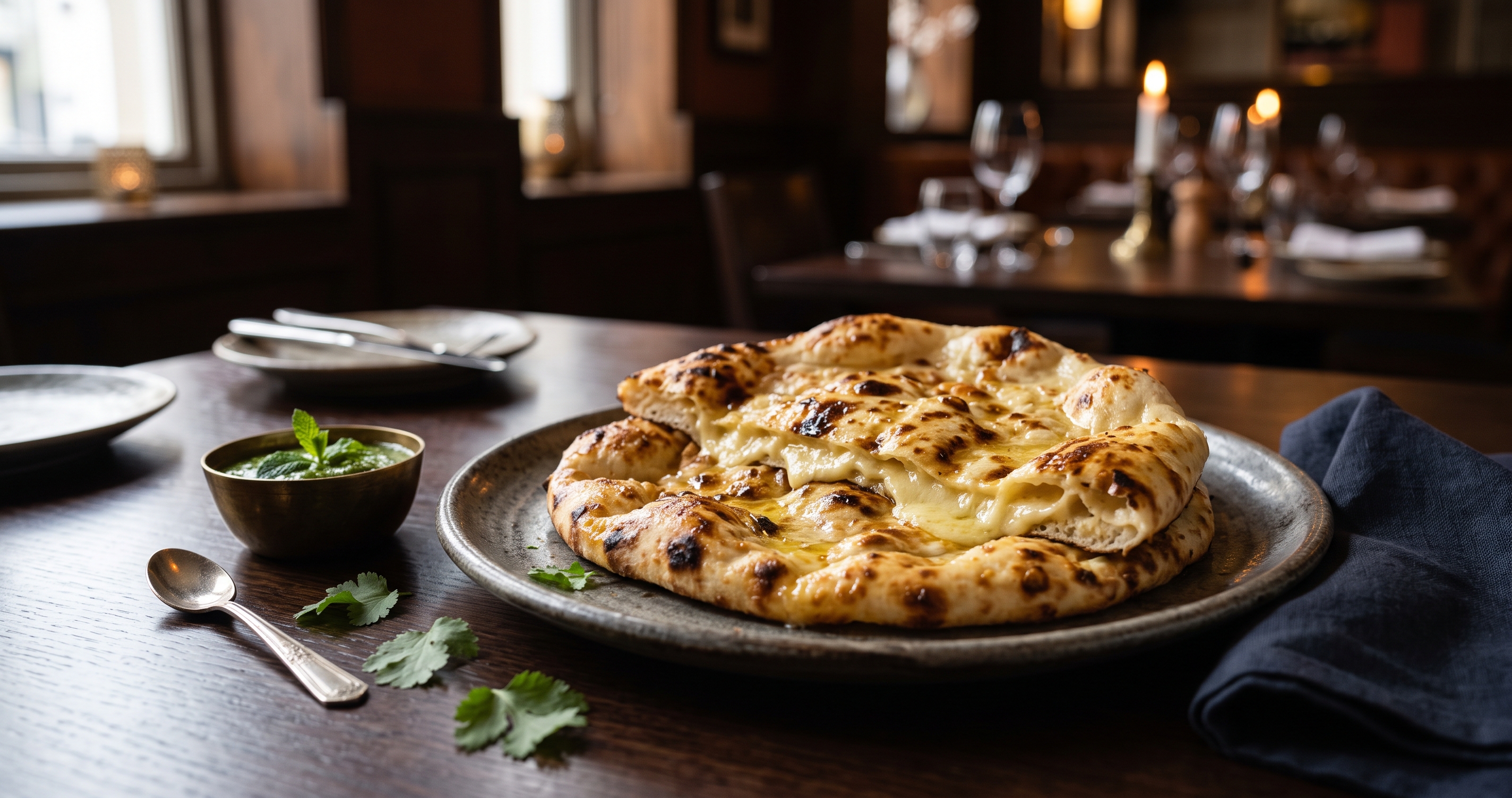
Restaurant-style cheese naan at home needs three things: a soft yoghurt-enriched dough, a low-moisture cheese filling sealed in like a dumpling, and far more heat than most home cooks dare to use. A smoking cast-iron pan followed by a blast under a very hot grill gets you close to a tandoor in about four minutes per bread.
What makes restaurant naan different from home naan?
Heat, mostly. A restaurant tandoor is a clay oven fired until its walls run at roughly 400°C or more. Dough slapped onto that wall sets underneath in seconds while the radiant heat from the coals puffs the top and blisters it. The whole bread cooks in about a minute and a half, which is why it stays soft inside. A domestic oven at 220°C bakes it instead, drying it out before it has a chance to char.
The second difference is dough. Good naan dough is soft, slightly sticky and enriched with yoghurt, which brings acidity and fat. The acid softens gluten and the lactic tang gives that faint sourness you taste under the char. Many home recipes use too much flour and too little liquid, and the result is closer to pitta.
The method below closes both gaps for cheese naan with ordinary kit.
Where does naan sit in Indian cuisine history?
A short bit of Indian cuisine history helps explain why naan is so tied to the tandoor. Clay ovens have been used across the region for thousands of years; remains of oven-like structures turn up at Indus Valley sites, though how closely they resembled a modern tandoor is debated. The word naan itself comes from Persian, where it simply means bread. Leavened wheat breads baked in tandoors became associated with royal and urban kitchens in the Delhi Sultanate and later the Mughal courts, and the poet Amir Khusrau is often cited as one of the earliest writers to mention naan, around the turn of the fourteenth century. For most households, though, everyday bread was roti or paratha from a flat tava; a tandoor needs space and fuel.
Stuffed and flavoured naans such as keema, peshwari and garlic are largely restaurant favourites. Cheese naan is newer still. Nobody can document exactly where it started; it is best understood as a restaurant creation that became a favourite in British Indian dining rooms.
Which cheese gives the best stretch and flavour?
This is where most attempts at cheese naan go wrong. Wet cheese releases steam, which pushes the dough apart from the inside and leaves a soggy pocket. Mild cheese tastes of nothing once it is wrapped in bread and charred.
| Cheese | Melt and stretch | Flavour | Verdict |
|---|---|---|---|
| Low-moisture mozzarella (block, grated) | Excellent stretch | Mild, milky | Use as the base |
| Mature cheddar | Melts well, oils out a little | Sharp, savoury | Blend with mozzarella |
| Fresh mozzarella (in brine) | Watery, steams | Very mild | Avoid |
| Paneer | Does not melt | Clean, creamy | Wrong job; use for kulcha-style fillings |
| Processed cheese slices | Very smooth | Salty, mild | Works mixed in for creaminess |
Our preferred blend for home cooks: two parts grated low-moisture mozzarella to one part mature cheddar. Add a pinch of chilli flakes, some finely chopped coriander and, if you like heat, a little chopped green chilli. Squeeze any herbs dry in kitchen paper first. Every drop of water counts.
The cheese naan recipe: quantities and dough
This cheese naan recipe makes six breads.
For the dough
- 500g plain flour (or half plain, half strong white for more chew)
- 7g sachet fast-action dried yeast
- 1 tsp caster sugar
- 1½ tsp fine salt
- ½ tsp baking powder
- 150g full-fat natural yoghurt, at room temperature
- About 170ml warm whole milk (around 37°C, comfortably warm on your wrist)
- 2 tbsp melted ghee or neutral oil, plus extra for brushing
For the filling
- 160g grated low-moisture mozzarella
- 80g grated mature cheddar
- 1 tbsp chopped coriander, 1 finely chopped green chilli (optional), pinch of chilli flakes
Method
- Whisk the yeast and sugar into the warm milk. Leave for 5 to 10 minutes until foamy.
- In a large bowl, mix the flour, salt and baking powder. Add the yoghurt, ghee and yeasted milk. Mix to a shaggy dough.
- Knead for 8 to 10 minutes until smooth and soft. It should feel slightly tacky. Resist adding flour; oil your hands instead. If it feels stiff, add milk a tablespoon at a time.
- Cover and leave somewhere warm for 1 to 1½ hours, until doubled.
- Knock back and divide into six balls of about 140g. Rest them under a cloth for 15 minutes so the gluten relaxes.
- Mix the filling and divide into six portions of about 40g.
How do you fill and shape cheese naan without it tearing?
Treat it like a dumpling. Flatten a dough ball into a disc about 12cm across, keeping the edges thinner than the centre. Pile the cheese in the middle and squeeze it together into a compact mound. Bring the edges up and over, pinch firmly to seal, then twist off any excess dough at the top. Turn it seam-side down.
Now roll gently. Press with your fingertips first to spread the cheese evenly, then roll from the centre outwards into a teardrop or oval roughly 5 to 6mm thick. If cheese breaks through, pinch a scrap of dough over the hole. Thin spots are where steam escapes and the naan deflates, so take your time here.
A tip from our side of the pass: rest the shaped naan for five minutes before cooking for a lighter crumb.
How do you cook it like a tandoor at home?
You will need a heavy cast-iron or carbon-steel pan and a grill that gets properly hot.
- Heat the grill to its highest setting with the rack about 10cm below the element.
- Heat the dry pan over high heat for at least 5 minutes, until a flick of water skitters and vanishes instantly.
- Lightly wet the top side of the naan with damp fingers. Lay it wet-side down in the pan. The moisture helps it grip, just as dough grips the wall of a tandoor.
- Cook for 60 to 90 seconds until large bubbles rise and the base is spotted dark brown.
- Move the pan under the grill for 1 to 2 minutes, until the top blisters and chars in patches.
- Brush immediately with melted ghee or butter, and scatter with nigella seeds or coriander if you like.
No grill? Flip the naan and cook the top in the pan for 45 seconds. You lose some puff but keep the char.
Stack cooked naans in a clean tea towel. The trapped steam keeps them soft while you cook the rest.
What are the most common problems?
- Dense and tough: too much flour during kneading, or not enough rising time.
- Pale and dry: the pan was not hot enough, so the bread baked slowly instead of charring fast.
- Burst cheese and a soggy middle: wet cheese, herbs not squeezed dry, or the dough rolled too thin.
- Flat, no bubbles: dead yeast or milk that was too hot. Above about 50°C you start to kill it.
Where can you try it in Covent Garden?
If you are looking for a restaurant Covent Garden locals and theatregoers use for proper Indian cooking, Paro is at 21 Wellington Street, right beside the Lyceum Theatre. Chef Niaz’s cooking is rooted in Kolkata and West Bengal, built on our house 48-spice mix. Breads change with the menu, so ask the Paro team which naans and stuffed breads are on when you visit.
Anyone looking for a restaurant Strand side will find us a couple of minutes’ walk away. Lunch runs Wednesday to Sunday from midday, and we look after pre-theatre and post-theatre guests. Our menu is tagged for gluten-free diners too; naan itself is a wheat bread, so tell us your needs and we will steer you to the right dishes.
Key Takeaways
- Keep the dough soft and slightly tacky; yoghurt adds tenderness and tang.
- Use low-moisture cheese, ideally two parts mozzarella to one part mature cheddar.
- Seal the filling like a dumpling and roll gently to 5 to 6mm.
- Use a smoking cast-iron pan plus a very hot grill to imitate a tandoor.
- Brush with ghee straight away and keep cooked naans wrapped in a tea towel.
Frequently Asked Questions
Can I make cheese naan without yeast?
Yes. Leave out the yeast, raise the baking powder to 2 teaspoons and add ½ teaspoon of bicarbonate of soda, which reacts with the acid in the yoghurt. Rest the dough for 30 minutes. The bread will be slightly less airy but still soft.
Why does my naan go hard after a few minutes?
It was probably cooked too slowly, which drives off moisture. Cook hotter and faster, brush with ghee and wrap in a tea towel straight away.
Can I make the dough ahead?
Yes. After the first rise it keeps, covered, in the fridge for up to 24 hours, and the slow rise adds flavour. Bring it back to room temperature for 30 to 45 minutes before shaping.
How do I reheat cheese naan?
Sprinkle a few drops of water on the surface and warm it in a hot dry pan for a minute each side, or wrap in foil and heat at 180°C for about 6 minutes. Microwaving makes it chewy.
Final Thoughts
A great cheese naan comes down to a soft dough, a dry filling and fierce heat. Get those right and your kitchen can turn out something close to what comes from a tandoor. When you would rather someone else did the kneading, come and see us at Paro on Wellington Street.