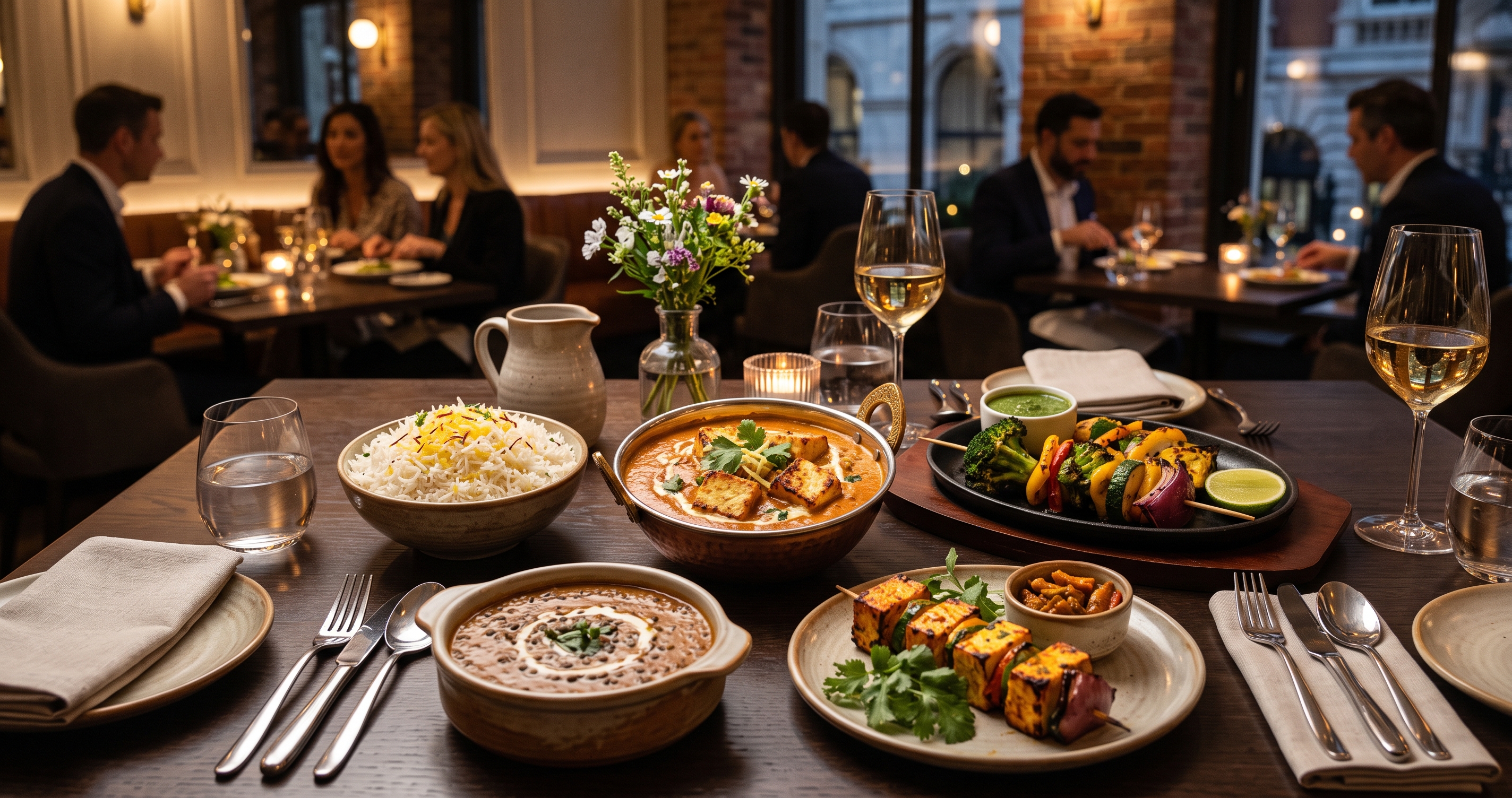
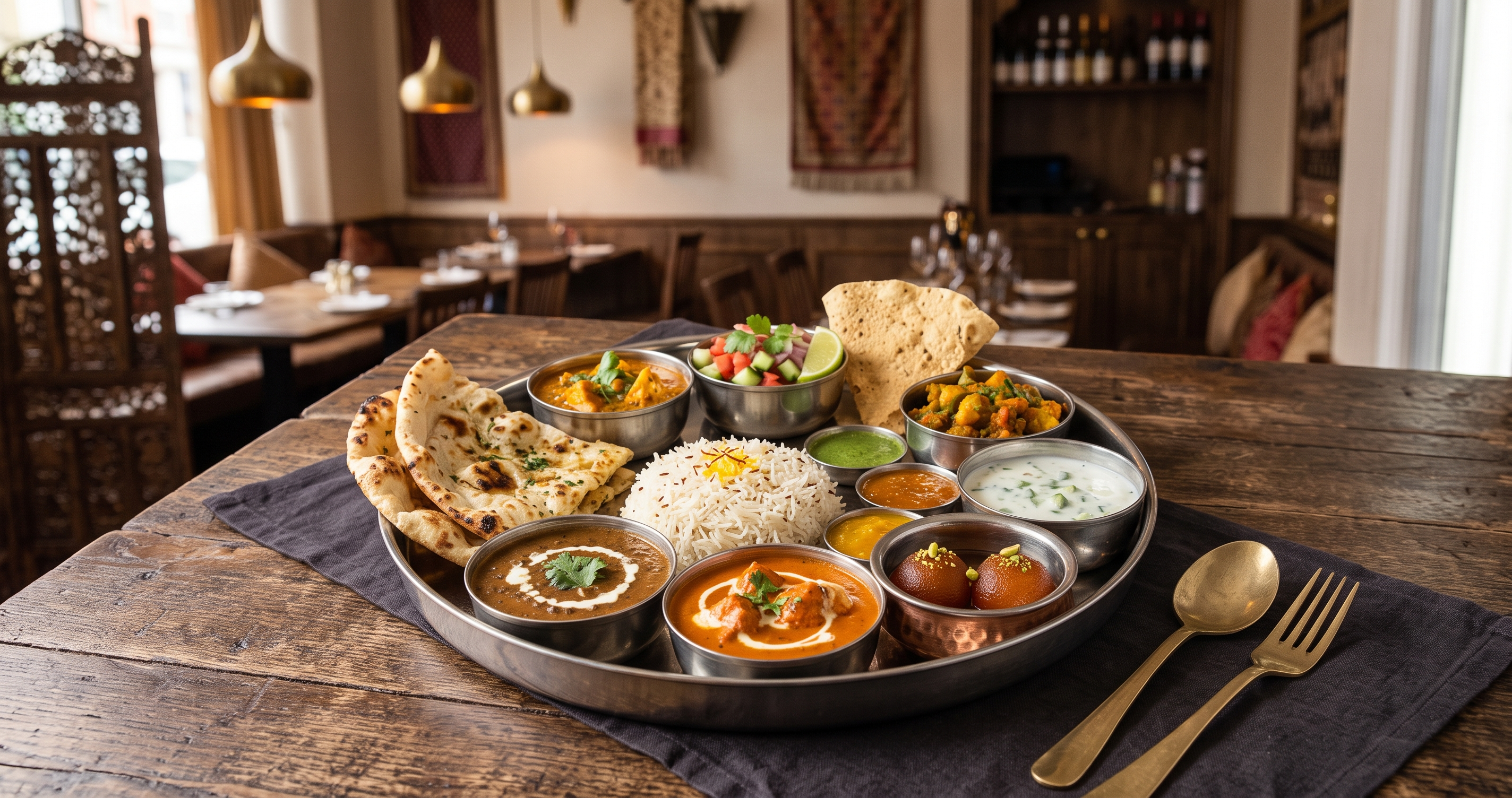
People love an Indian thali London style because one plate gives you a whole meal in miniature: a dal, a dry vegetable, a gravy dish, rice, bread, a pickle, yoghurt and something sweet. Every mouthful can change. You control the balance of heat, sourness and richness yourself, so the meal never gets monotonous.
A good thali is not a random collection of small bowls. It follows a logic, and once you understand it you will eat one differently.
What exactly is a thali?
The word simply means “plate” in Hindi, and in Bengali the same idea is often called a thala. Traditionally it is a round metal tray, usually steel, brass or bell metal, with small bowls called katoris set around the rim. Rice or bread sits in the middle. In the south the same meal is often served on a banana leaf instead.
What goes into the bowls depends on the region and the household. A Gujarati thali leans sweet and tangy, with a thin dal sharpened by jaggery and kokum. A Bengali spread, the tradition Chef Niaz grew up with, is traditionally eaten in courses: something bitter first to wake the palate, then dal with fried vegetables, then fish or meat, then a chutney, then sweets.
So when you search for an Indian thali London restaurant, you are really looking at one of dozens of regional formats. Asking which region the plate is drawing from tells you a lot about what to expect.
Why does a thali taste better than one big curry?
This is the question we get asked most at the pass, and the answer is mostly about the palate getting tired.
Eat a single rich curry and your palate adapts. The first spoonful of a buttery tomato sauce is thrilling; the fifteenth barely registers. Food scientists call this sensory-specific satiety: you feel full of that flavour long before you are actually full.
A thali gets around this by switching the stimulus constantly. A bite of creamy dal, then a sharp pickle, then cool yoghurt, then a dry, toasted vegetable with crunch. Each contrast resets your palate, so the tenth bite tastes almost as vivid as the first.
There is also textural logic. Good thalis deliberately mix:
| Element | Typical example | What it does on the plate |
|---|---|---|
| Liquid | Dal, rasam, thin curry | Moistens rice, carries spice |
| Dry | Stir-fried greens, potato bhaji | Adds bite and toasted flavour |
| Rich | Paneer, lamb or chicken in gravy | The centrepiece, slow and deep |
| Sour | Pickle (achar), tamarind chutney | Cuts through fat |
| Cooling | Raita, plain yoghurt | Calms heat between bites |
| Sweet | Kheer, a small mithai | Closes the meal |
How should you actually eat a thali?
First-timers often finish one bowl before starting the next. That misses the point. Try this instead.
- Taste everything on its own first. One small spoonful of each bowl. This tells you where the heat and the salt sit.
- Make a small mound of rice. Pour a little dal over it and mix with your fingers or a spoon. This is your base.
- Build combinations. Rice and dal with a pinch of pickle. Bread wrapped around a piece of dry vegetable. A bite of the rich gravy followed by a spoon of raita.
- Use the bread as a tool. Tear a piece, pinch it round some food, eat. In many homes the bread replaces cutlery entirely.
- Save the sweet for last. It is there to close the meal, and it tastes far better after the savoury dishes.
If you are eating with your right hand (the traditional way), use your fingertips, not your palm, and push food into your mouth with your thumb.
What drink goes with a thali?
Lassi is the classic. A sweet or salted yoghurt drink coats the mouth and counters chilli heat better than water, because the fat and the casein protein in dairy bind to capsaicin, the compound that makes chilli burn. Water just spreads it around.
That is why so many people type mango lassi near me after ordering spicy food. A mango lassi made with ripe Alphonso or Kesar pulp, full-fat yoghurt and a pinch of cardamom is thick enough to stand a spoon in briefly, and it pairs particularly well with a thali where one or two dishes carry real heat. If you are visiting us, ask the team what drinks are on the day; a lassi or a cold lager both work well with a varied plate.
Is a thali good for groups and mixed diets?
Very much so, and this is one of the reasons it suits a busy restaurant West End setting. Because a thali is built from separate components, it is easy to swap one bowl for another. A vegan diner can have a coconut-based vegetable in place of a paneer dish. A guest avoiding gluten can lean on rice instead of bread.
At Paro our menu is tagged for halal, vegan, vegetarian, gluten-free, dairy-free and nut-free diners, which makes building a balanced spread straightforward. If you want to eat this way, tell your server how many people you are and any dietary needs, and ask them to help you put together a range of textures rather than three similar curries.
Why does a thali suit a theatre night?
Timing. A thali arrives all at once, so there is no waiting between courses. For guests heading to a show, that matters more than almost anything else.
Paro sits at 21 Wellington Street, right beside the Lyceum Theatre, and many of our guests are on a clock. People searching for the best Indian restaurants near Fortune Theatre London are usually after the same thing: good cooking served quickly enough to make the curtain. The Fortune is a short walk from us on Russell Street, as are the Royal Opera House and Covent Garden Piazza. A meal built from several small dishes lets everyone at the table eat at their own pace and finish together, which is far easier than coordinating separate mains and sides.
Our tip: tell the team your curtain time when you sit down. The kitchen can pace the food around it.
What makes a thali feel authentic?
A few markers separate a real Indian thali London diners will remember from a plate of leftovers in small bowls:
- The dal is properly tempered. A tadka of whole spices bloomed in hot ghee or oil (cumin, mustard seed, dried chilli, perhaps garlic) is poured over at the end. You should smell it before the plate lands.
- The dry vegetable is actually dry. If it is sitting in liquid, it was cooked too far ahead.
- There is something sour and something cooling. Without pickle and yoghurt, the balance falls apart.
- The rice is separate, not clumped. Good basmati is rinsed, soaked for about 20 to 30 minutes, and cooked so each grain stands apart.
- Spices differ from bowl to bowl. If every dish tastes of the same garam masala, the cook has taken a shortcut.
That last point is why our kitchen works from a house 48-spice mix rather than one generic blend. Chef Niaz draws on different combinations for different dishes, so a dal and a meat curry on the same table taste distinctly of themselves.
Frequently Asked Questions
What is usually included in an Indian thali?
A typical thali includes rice and/or bread, a dal, one or two vegetable dishes, a meat, fish or paneer dish, a pickle or chutney, yoghurt or raita, and a small sweet. The exact line-up varies by region and by kitchen.
Is a thali enough food for one person?
Yes. Although each portion is small, the combined volume is a full meal, and the refillable thalis served in parts of India can be very generous. Most people find a thali more filling than they expect.
Can vegans and vegetarians eat a thali?
Many traditional thalis are entirely vegetarian, especially in Gujarat and Rajasthan. Vegans should check the dal and vegetables for ghee, cream or yoghurt, and ask the kitchen for dairy-free swaps.
Do you eat a thali with your hands?
Traditionally yes, using the right hand and fingertips. Cutlery is perfectly acceptable in a restaurant and nobody will judge you for it.
Where can I find an Indian restaurant in Covent Garden for a pre-theatre meal?
Paro is at 21 Wellington Street, beside the Lyceum Theatre, and regularly serves pre-theatre and post-theatre guests. Tell the team your show time on arrival so the kitchen can pace the food.
Final Thoughts
The joy of an Indian thali London style is that you are never eating the same bite twice. It is a format built on contrast, balance and choice, and it suits how people actually like to eat: a little of everything, shared, at their own speed.
If you are looking for an Indian restaurant Covent Garden locals and theatregoers rely on, come and eat with us at Paro. Bring friends, order a spread of small dishes across textures, and let Chef Niaz’s kitchen show you what a well-balanced Indian table can taste like.