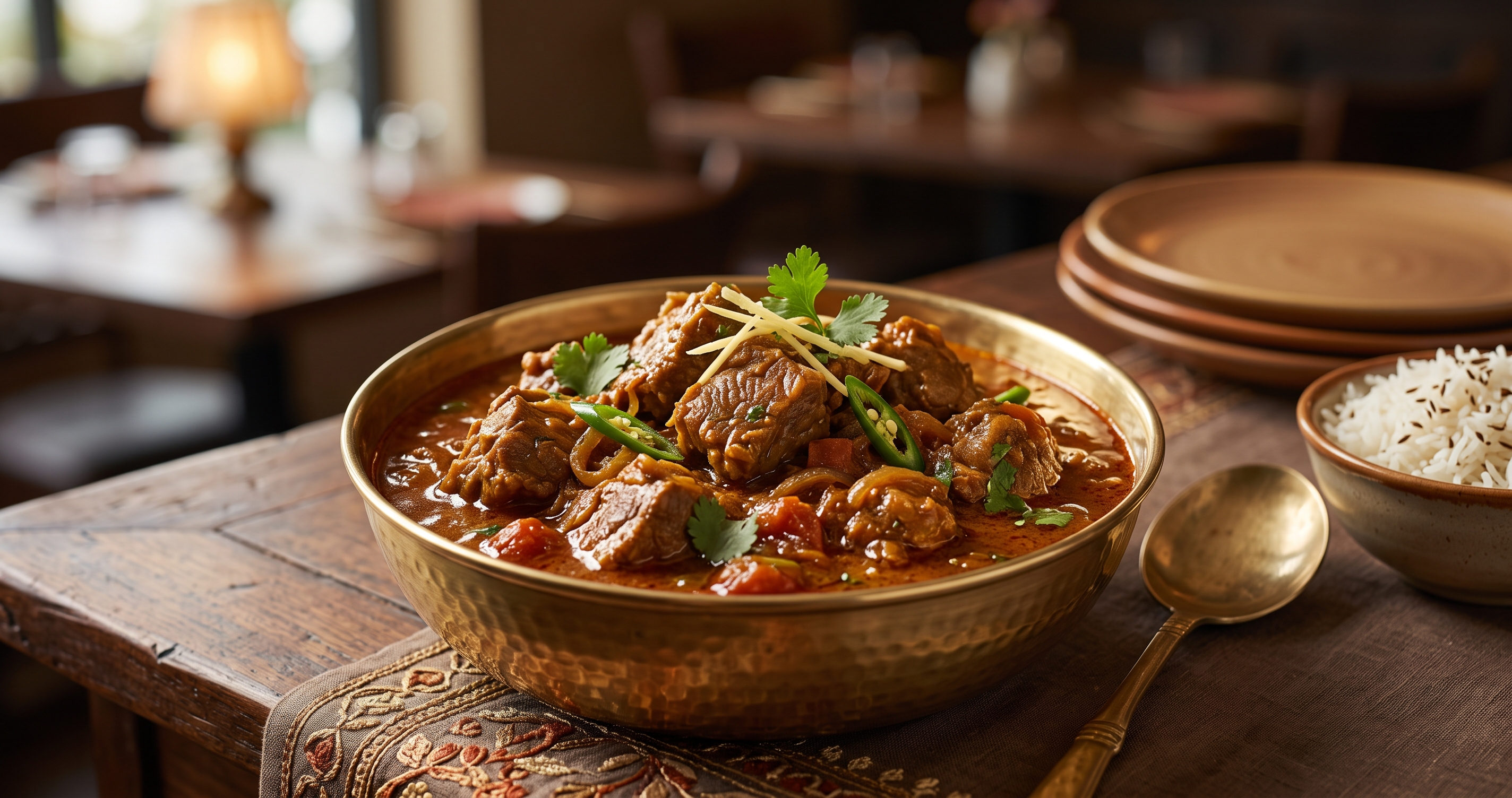
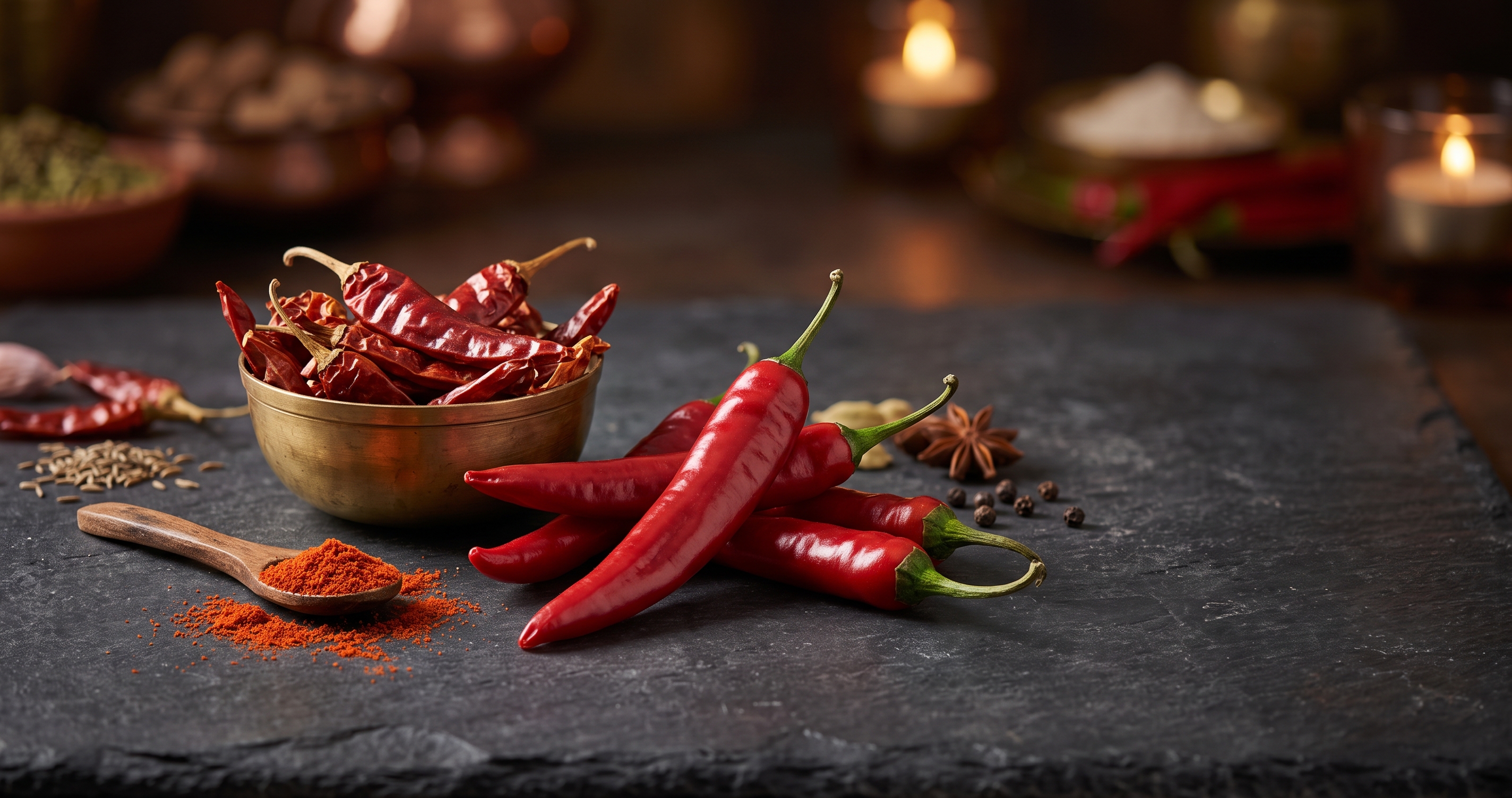
Indian chefs use Kashmiri chilli because it delivers an intense, brick-red colour with only mild heat. Bloomed in oil and worked into a yoghurt marinade, it stains meat, paneer and vegetables a deep red that survives the tandoor’s fierce heat, so a grill can look fiery while tasting warm, smoky and gentle.
That red you see on a good tandoori chicken is not food colouring, or at least it should not be. It comes from a mild dried chilli associated with the Kashmir valley and from a few techniques that make the most of it. Here is how our kitchen does it.
What is Kashmiri chilli?
It is a long, wrinkled, dark red dried chilli traditionally grown in Jammu and Kashmir. Its two defining traits are high colour and low heat. On the Scoville scale it is usually quoted somewhere around 1,000 to 2,000 units, which puts it at the mild end, roughly in the territory of a poblano and far below a bird’s eye chilli.
The flavour is fruity and slightly smoky, with none of the sharp, grassy burn of hotter varieties. In Kashmiri cooking, particularly in dishes like rogan josh, it is the main source of the dish’s colour. The rogan in the name is often linked to the red oil that rises to the surface, though food historians argue over the exact meaning.
One honest note. Genuine Kashmir-grown chilli is scarce and expensive, and much of what is sold under that name is a similar mild, high-colour variety grown elsewhere, often Byadgi chilli from Karnataka, or a blend. That is fine for cooking. Just be aware that the label describes a style as much as a place.
Why is it so red but not very hot?
Two different compounds are at work, and they are independent of each other.
- Capsanthin and capsorubin are the red carotenoid pigments. This chilli is unusually rich in them.
- Capsaicin is the compound that makes chilli hot. This variety contains relatively little.
The red pigments are fat-soluble. That is the key to everything that follows. Stir the powder into plain water and you get a dull, rusty liquid. Warm it gently in oil or ghee and the oil turns a glowing scarlet, because the pigment has dissolved into the fat and can now coat whatever you cook.
| Chilli | Approx. heat | Colour strength | Best use |
|---|---|---|---|
| Kashmiri | Mild | Very high | Tandoori marinades, rogan josh, colour without fire |
| Byadgi | Mild | High | South Indian curries, a common substitute |
| Guntur | Hot | Medium | Andhra dishes, heat-led curries |
| Bird’s eye | Very hot | Low | Fresh heat, small quantities |
Many chefs blend them: Kashmiri for colour, a pinch of something hotter for kick.
How do chefs build a tandoori marinade with it?
In most serious tandoori kitchens the marinade comes in two stages. This is the method we would teach any home cook, scaled for about 1 kg of boneless chicken thigh.
- First marinade (30 minutes). Toss the meat with 1 tsp salt, 2 tbsp lemon juice and 1 tbsp ginger-garlic paste. The acid and salt start seasoning and loosening the surface proteins.
- Bloom the chilli. Warm 3 tbsp neutral oil or mustard oil until just shimmering, take it off the heat, then stir in 2 tbsp Kashmiri chilli powder. It should sizzle softly and turn the oil red. Do not let it smoke, or it will turn bitter and brown.
- Second marinade. Mix 200 g thick Greek-style yoghurt (strained, so it clings rather than drips) with the cooled red oil, 1 tsp garam masala, 1 tsp roasted ground cumin, 1 tsp crushed dried fenugreek leaves and a little more salt. Coat the meat thoroughly.
- Rest. Refrigerate for 6 to 12 hours. Chicken longer than about 24 hours can turn mushy at the surface.
- Cook hot. A tandoor runs at 400°C or more. At home, use the highest grill setting or an oven at 250°C on a rack, roughly 15 to 20 minutes for thigh pieces, turning once, until the internal temperature reaches 75°C and the edges char.
Why yoghurt? Its lactic acid is gentle. It loosens the outer layer of meat without turning it chalky the way strong citrus can over a long marinade, and the milk proteins and sugars brown well, giving those dark, blistered edges.
Does it work on vegetables and paneer?
Very well. Paneer tikka, cauliflower, mushrooms and peppers all take the same yoghurt and chilli marinade, though they need far less time: 30 minutes to 2 hours is plenty. Because paneer contains fat, the red pigment sticks to it beautifully.
For a vegan version, swap the yoghurt for a thick paste of gram flour toasted in a little oil, loosened with lemon juice. It clings well and chars nicely. Our menu is tagged for vegan, vegetarian, gluten-free and dairy-free diners as well as halal, so if you have a dietary need, ask the team how a grilled dish can be adapted.
Where does the tandoor fit in Indian food history?
Clay ovens of the tandoor type have a long history across Central and South Asia, and earth ovens have been found at very old sites in the region. Tandoori chicken as most of the world knows it, though, is a much more recent dish. It is widely credited to Moti Mahal in Delhi, founded after Partition by Punjabi cooks who had come from Peshawar, though as with many famous dishes the details of who invented what are disputed.
What is clear from Indian food history is that the vivid red of tandoori chicken became its signature as the dish spread. Some restaurants reached for artificial red colouring to achieve it. A good mild red chilli is how cooks get that look naturally, and it is the approach we believe in.
What mistakes stop a tandoori grill going deep red?
- Adding the powder dry. Without blooming in fat, the colour stays muddy.
- Burning the oil. Overheated chilli turns brown and acrid in seconds.
- Wet yoghurt. Thin yoghurt slides off the meat and steams instead of charring. Strain it.
- Too low a heat. Without fierce heat you get stewed, orange meat rather than a red crust with black edges.
- Crowding the tray. Pieces packed close together steam each other. Leave space.
Key Takeaways
- Kashmiri chilli gives strong red colour with mild heat because it is high in red pigments and low in capsaicin.
- Its colour is fat-soluble, so bloom it in warm oil before adding it to a marinade.
- A two-stage marinade, acid first and spiced yoghurt second, gives tender meat and a red, charred crust.
- Real tandoori colour comes from technique and good chilli, not dye.
Frequently Asked Questions
Is Kashmiri chilli hot? No, it is one of the milder chillies used in Indian cooking. It adds warmth and colour rather than strong heat, which is why chefs can use it in generous quantities.
What is a good substitute for this chilli powder? Mix about three parts sweet paprika with one part ordinary chilli powder for a similar colour and gentle heat. Byadgi chilli powder is an even closer match if you can find it.
Why is my tandoori chicken orange instead of red? Usually the chilli was not bloomed in oil, the heat was too low, or too much turmeric was used. Blooming the powder in warm fat and cooking very hot gives a deeper red.
Is tandoori chicken halal? It can be, depending on how the chicken is sourced and slaughtered. If you are looking for a halal restaurant in central London, ask the restaurant directly; Paro’s menu is tagged for halal diners.
How long should tandoori chicken marinate? Six to twelve hours in the fridge is ideal for chicken. Paneer and vegetables need only 30 minutes to two hours.
Final Thoughts
Kashmiri chilli is one of the quiet tools that separates a good tandoori grill from a great one. It gives the colour people expect, keeps the heat friendly, and rewards cooks who understand how to bloom it.
If you are after a halal restaurant central London diners can rely on, or want halal fine dining London style with serious attention to spice, come and see us at Paro, 21 Wellington Street, beside the Lyceum Theatre. If you are choosing a restaurant Covent Garden for real kitchen craft, Chef Niaz’s kitchen is a fine place to start.