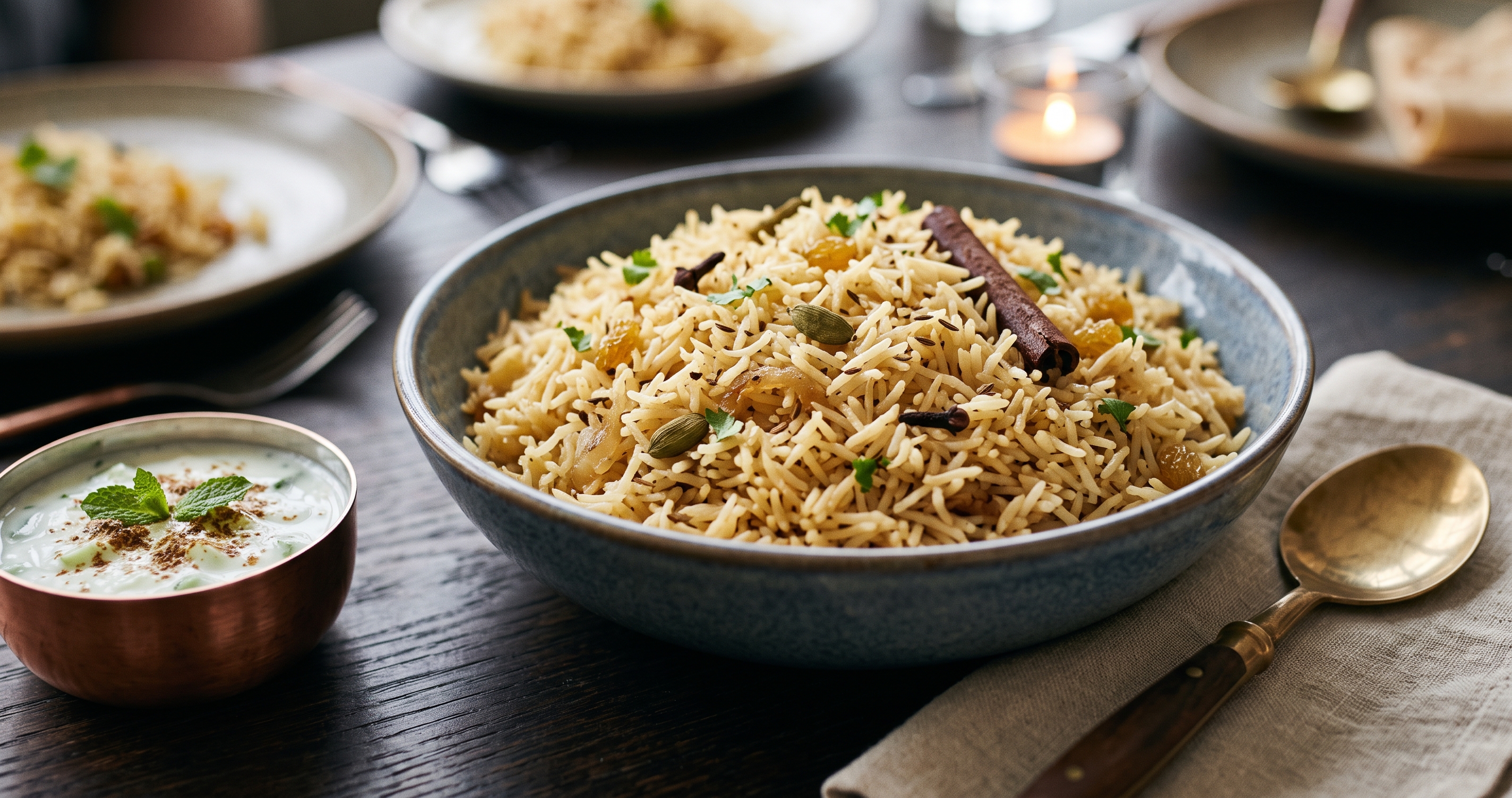
pulao rice is cooked in one pot, with the rice absorbing a measured amount of stock until it is all gone. Biryani is built in layers, with rice parboiled separately in plenty of water, then sealed with meat or vegetables and steamed. One method gives gentle, evenly seasoned grains. The other gives contrast in every spoonful.
What Actually Separates The Two Methods?
Think of it as absorption versus assembly.
For pulao, everything happens in a single pan. Whole spices go into hot ghee, onions follow, then the meat or vegetables, then rinsed and soaked rice. You add a fixed volume of liquid, often the stock the meat was simmered in, cover, and let the rice drink it. Nothing is drained. Every grain is cooked in the same seasoned liquid, so the colour and flavour run evenly through the pot.
Biryani starts with two separate components. The rice is boiled in a large volume of heavily salted, spiced water until it is roughly 70 per cent cooked (the grain snaps between your fingers with a thin, hard core still inside), then drained. The meat is either cooked into a rich masala first or layered in raw after a long marinade. The two are layered, often with saffron milk, fried onions and ghee between them, sealed, and steamed on low heat, a process called dum. The rice finishes in the steam rising from the meat.
That difference is why biryani tastes uneven in the best way. A spoonful from the bottom is soaked in masala; a spoonful from the top is fragrant, white and saffron-streaked. Pulao rice is calmer and more consistent.
| Pulao | Biryani | |
|---|---|---|
| Rice cooking | Absorption in measured stock | Parboiled in excess water, drained, then steamed |
| Pots used | One | Usually two, then combined |
| Structure | Mixed through | Layered |
| Spice level | Gentle, mostly whole spices | Bolder, whole and ground spices plus a masala layer |
| Texture | Uniform, each grain evenly coloured | Contrasting layers, some grains white, some coated |
| Typical time | 40 to 60 minutes | 1.5 to 3 hours including marinade |
Where Do Pulao And Biryani Come From?
The broad story is well established, though the details are argued over. Rice cooked in seasoned broth with meat appears across Persia, Central Asia and the Middle East under names like pilaf, polow and palov, and Sanskrit texts mention spiced rice and meat dishes long before that. Pulao in South Asia most likely grew from those Persian-influenced traditions.
Biryani is generally linked to the Mughal court, with the name usually traced to the Persian birian, meaning fried or roasted. Many families and regions claim the “original”, and nobody can settle it. What we can say with confidence is that by the nineteenth century regional styles had split clearly: Lucknow’s restrained pakki biryani, Hyderabad’s kacchi style with raw marinated meat, and others.
Kolkata’s version matters to us. Chef Niaz’s cooking is grounded in Kolkata and West Bengal traditions, and Kolkata biryani is lighter on chilli, perfumed with a little rose or kewra water and famously includes a potato. The usual story connects it to the cooks of Wajid Ali Shah, the last Nawab of Awadh, who was exiled to Kolkata in 1856. The claim that potatoes were added because meat was scarce is popular but disputed; others argue potatoes were a prized ingredient at the time. Either way, a soft, stock-soaked potato in a biryani is pure Kolkata.
Bengal has its own pulao culture too, including sweet, yellow, ghee-rich versions served at festive meals. The word covers a lot of ground.
Why Does Basmati Break, And How Do You Keep The Grains Long?
Long-grain basmati is fragile. Most broken grains come from three mistakes.
Not soaking. A dry grain dropped into hot liquid cooks on the outside while the core stays hard, and that stress cracks it. Soaking for 20 to 30 minutes lets water reach the centre so the grain swells evenly. It also lets basmati lengthen properly; well-soaked aged basmati can nearly double in length.
Not rinsing. Loose surface starch turns to glue as it heats. Rinse three or four times until the water runs almost clear.
Stirring. Once the rice is in the liquid, a spoon is the enemy. Fold once, gently, when you add the rice, then leave it alone. For pulao, fluff with a fork only after resting.
Fat helps too. Briefly frying soaked, drained rice in ghee before adding stock coats each grain and keeps it separate. That step is one reason restaurant pulao rice looks so glossy and loose.
How Do You Cook A Proper Chicken Pulao At Home?
This chicken pulao serves four and uses the absorption method in a heavy pan with a tight lid.
- Rinse 300 g aged basmati until the water is nearly clear, then soak for 30 minutes. Drain well.
- Season 600 g bone-in chicken thighs with 1 tsp salt and 1 tbsp ginger-garlic paste.
- Heat 3 tbsp ghee over medium heat. Add 1 bay leaf, 4 green cardamom pods, 4 cloves, a 4 cm piece of cinnamon and 1 tsp cumin seeds. When the cumin crackles (about 30 seconds), add 2 thinly sliced onions and cook for 10 to 12 minutes until deep golden.
- Add the chicken and fry for 5 minutes until sealed. Add 3 tbsp yoghurt and 2 slit green chillies and stir for 2 minutes.
- Pour in 750 ml hot water or light chicken stock, add 1 tsp salt and simmer for 15 minutes until the chicken is nearly tender.
- Measure the liquid. You want about 500 ml for 300 g soaked rice (roughly 1.7 times the dry weight). Top up or reduce as needed.
- Bring back to a boil, add the drained rice, fold once, and cook uncovered on medium heat until the liquid drops to the level of the rice and small craters appear on the surface, about 6 to 8 minutes.
- Cover tightly and turn the heat to its lowest setting for 12 minutes. Turn off the heat and leave covered for another 10.
- Fluff with a fork and finish with a handful of chopped coriander and a few drops of lemon.
Resting is not optional. Those final ten minutes let moisture spread from the wet bottom grains to the drier top ones.
How Do Indian Spices Behave Differently In Each Dish?
In pulao, whole indian spices do most of the work. They are bloomed in fat, and their oil-soluble aromatic compounds dissolve into the ghee, which then coats the rice. That is why a good pulao smells strongly of cardamom and clove without tasting hot.
Biryani layers spice. Whole spices go into the parboiling water, ground spices go into the meat masala, and finishing aromatics such as saffron, rose water or kewra are added just before sealing because their volatile compounds would be lost in a long boil.
At Paro our 48-spice house mix lives mostly in the masala side of the kitchen. For rice, we lean on whole spices and good stock, because rice punishes heavy-handed seasoning more than any curry does.
Which Should You Order, And What Should You Eat With It?
Order pulao when the curries on the table are the stars. Its gentle seasoning supports a rich dal, a fish curry or a slow-cooked lamb dish without competing.
Order biryani when you want the rice to be the main event. It already carries meat, spice and fat, so it needs only a cooling raita and perhaps a simple salad. Putting a heavy curry on top of biryani muddles both.
Many indian restaurants london wide serve biryani as a one-pot centrepiece and pulao as a side, and that is a sensible way to read a menu. Among Restaurants Central London close to the theatres, timing matters too. A properly sealed biryani takes time to come to the table, so if you are watching the clock before a curtain, tell your server.
Frequently Asked Questions
Is pulao healthier than biryani?
Usually pulao uses less fat and fewer fried onions, so it is often lighter. It depends entirely on the recipe, though, as a ghee-rich pulao can be just as indulgent.
Can you make biryani with the absorption method?
Some home cooks do, and it can taste good, but the result is closer to a pulao. The layered, contrasting texture comes from parboiling and steaming separately.
What rice-to-water ratio works for pulao?
For soaked aged basmati, about 1.6 to 1.8 parts liquid to 1 part dry rice by weight, cooked covered on low heat. Newer, less aged rice needs slightly less water.
Final Thoughts
The gap between the two is method, not ingredients. Pulao rice absorbs its flavour gently and evenly; biryani is assembled for drama and contrast. Learn the soak, the measure and the rest, and both become reliable at home. If you are in Restaurants West End territory before or after a show, we would be glad to see you at Paro on Wellington Street, where you can ask the team how the kitchen is cooking its rice that day.